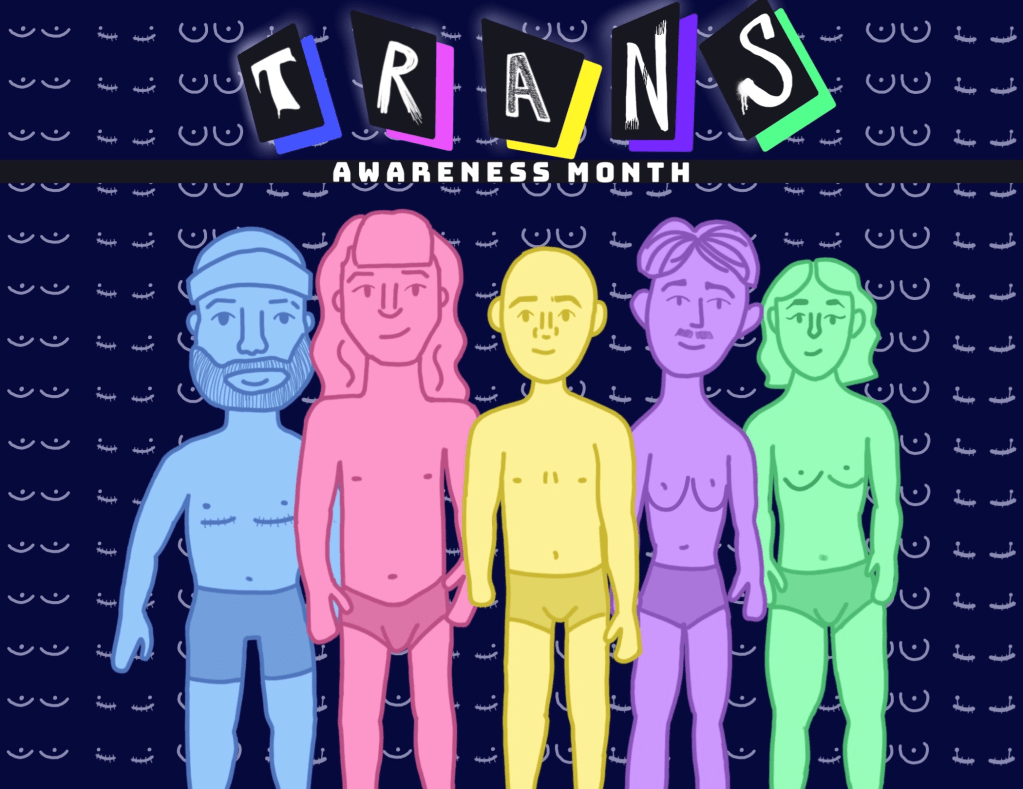
“No matter gay, straight, or bi’, lesbian, transgender life. I’m on the right track, baby, I was born to survive.” As Lady Gaga said, it shouldn’t matter whether we are cishet or queer. November is the month of trans awareness, but what does that really mean?
Trans Awareness Month is the time of the year when we focus on trans people – their needs, their issues, and what we can do to make them feel better in our world. You may ask, “Okay, but then why don’t we have a cisgender awareness month?” And that is a valid question. The primary reason for that is that we focus on cisgender heterosexual people all year long – after all, the default in our society is to be cishet (cisgender, heterosexual), so the queer community has to somehow work with that. This month, non-cishet individuals can “take up space” and talk about their needs and problems.
The best way to acknowledge trans people this month is to educate yourself on the topic. This can be your starting point.
Transgender is an umbrella term, which means that there are other, more specific terms that you can use. Under the word “trans” hide terms such as non-binary, agender, gender-fluid, etc.
Non-binary is a gender identity used to describe a person who doesn’t identify with the binary idea of the world, which divides people into male or female. This is also an umbrella term, as there are many other gender identities that don’t accept the binary division, such as agender (someone who doesn’t identify with any gender), demiboy, and demigirl (someone partially identifying as male or, in the second case, female).
Pronouns are a really controversial topic. Many people claim that using pronouns other than “she” and “he” (as singular in the third person) is grammatically incorrect. Even if that were true, many don’t believe that grammar should ever be more important than the well-being of another human being.
Misgendering happens when someone doesn’t use the right pronoun when talking to another person.
This can be a real struggle for trans people and can cause gender dysphoria. It is a feeling of distress that can be induced by a mismatch between one’s gender identity and their birth-assigned sex. Many things can trigger it – misgendering, for instance, or physical appearance (eg. your chest being too big or too small, etc.)
I believe that this is enough for a start. Remember that it is not at all difficult to ask someone for their pronouns. If we normalize that, it will definitely make many trans people feel seen and heard. If you’re not sure about anything, just ask! It’s a good thing to have questions, and, after all, it is definitely better than having a misunderstanding.




 The Warsaw High School Times
Leave a comment