Graphic by Milena Targańska
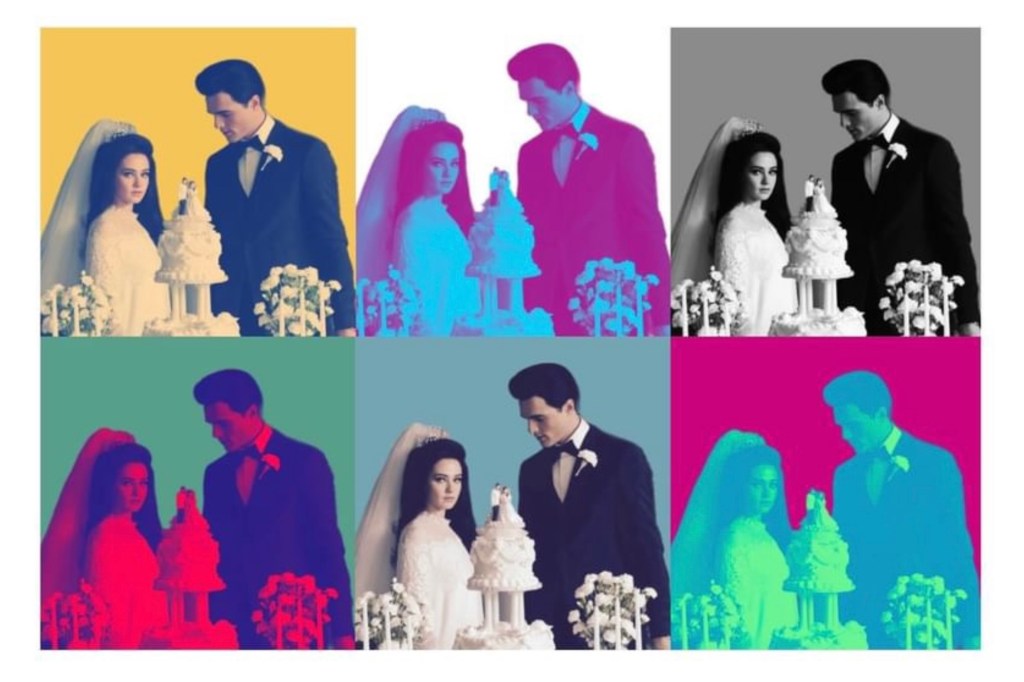
“Priscilla” begins innocently enough: with pastel shots of the protagonist’s extruded eyelashes, her freshly-painted ruby lips and perfectly-pedicured feet strolling nonchalantly across a pink furry carpet. The candy-colored Barbie-style exposition, however, has nothing to do with Priscilla’s life alongside Elvis, as Sofia Coppola shows shortly thereafter on screen. Here, pastel interiors, satin gowns and satin beds are drenched with the tears of an unhappily in love teenager who sincerely believed that the love of the most desirable man in America was the best thing that ever happened to her. Coppola’s film is an adaptation of the intimate confessions of Elvis’ wife from a book published in 1985 entitled “Elvis and Me”. The director focuses on the female perspective, filtering pop culture’s familiar image of the King of Rock ‘n’ Roll through the gaze of Presley’s former, now 78-year-old wife. This moving film is titled “Priscilla” for a reason.
Germany, 1959 – fourteen-year-old Priscilla Beaulieu, the daughter of an American officer stationed in Germany, meets the ten years older Elvis Presley at a party. Elvis, already a musical icon overseas, misses America, and fears that no one will remember him again when he returns from duty. The young and shy Priscilla becomes his “American baby,” a sweet comfort and a beautiful reminder of his beloved homeland. Elvis quickly wins the heart of the girl and her parents, but soon leaves Germany, leaving Priscilla in emotional tatters.
Just recall your first crush – full of naiveté, butterflies fluttering in your stomach and constant self-doubt. In the case of Priscilla, it only takes one phone call from Elvis to turn her entire world on its head. Without hesitation, seventeen-year-old Beaulieu gets on a plane and starts a new life at the side of the man of her dreams, who, over time, will begin to look less and less like the Elvis she met years ago in Germany. The girl becomes a hostage of Graceland. She can’t work, invite her schoolmates over, or expose herself to the prying eyes of the wild Elvis fans casing the estate. The luxurious mansion and expensive gifts don’t fill the void that lies within Priscilla. It seems to her that she has become, at her own request, the realization of Elvis’ fantasy of the perfect woman – polite, quiet and compliant.
Priscilla becomes Elvis’ little sister, so to speak, left in the custody of his strict father while the boy is on film sets and leading a celebrity life. As if there were a parcel machine at the gates of Graceland, she is sent and returned with a complaint. This goes on for years, as first, before they can be married, she has to finish Catholic school. When she succeeds, however, the situation does not change. An arrangement based on centering their entire lives around a man’s affairs, with the woman being treated more as a toy, prevails between them even when they are already married, when she is pregnant, and when their daughter is brought into world. An entire séance passes before Priscilla begins to belong to herself. Her liberation as she drives away to the sounds of Dolly Parton’s “I Will Always Love You” – the anthem of all people who have awakened from a toxic relationship – is the last (and should be the first) scene of a film about a woman awakened from the hypnosis of love.
Director Sofia Coppola knows how to show like no one else the suffocating, claustrophobic world of luxury that poisons you with guilt and loneliness and gives you a sense of unreality. With extraordinary talent, she paints a girl’s imagination trapped in a perpetual dream. The crucial moment when the heroines of her films are supposed to finally stop suffering, find some meaning and start being happy, never happens.
“Priscilla” leaves a deficiency compared to the director’s best films, perhaps because the adaptation of the book-length autobiography “Elvis and Me” takes her point of view for granted. It doesn’t differentiate it, doesn’t look at it from different sides, doesn’t put question marks. It limits itself only to the time when the enchanted woman is still under the influence of the illusion. One would like to know a snippet of her life when she is already herself, awakened from hypnosis. In this context, “Priscilla” watches like a personal confession of the film’s protagonist. In the context of this confession, the lack of a sex life with Elvis is particularly surprising. The man desired by the crowds is unwilling or unable to create intimacy in a relationship. He and Priscilla have a child from one of their few close-ups over many years. His partner’s needs remain unmet.
Coppola’s mistake is that she cast peers in the main roles, even though the theme of the story is age difference. What it’s like to always be the youngest among adults has been shown, but the decade separating ages 14 and 24 is huge, not to say crucial. The dominance of the older partner and his nature, overlooked by the much younger partner, is an important theme in such romances. The casting decision to make Elvis and Priscilla appear to be of similar age may be justified by the assumed unrealistic optics of the girl. However, the result does not give the feeling that we are dealing here with the manipulation of a child by an unbalanced adult.
Elvis changes Priscilla’s hair color, tells her how she should paint, comb and dress. We have barely watched “Barbie,” and already we are seeing a living doll being played with by a grown man. Cailee Spaeny, who looks like one, keeps almost the same grimace on her face. She lets herself tie bows and tousle her hair. She gives the impression that she feels nothing, for a moment only frightened when Elvis throws a chair at her. No mockery, amazement or satisfaction are painted on her face. She seems almost the same from beginning to end. It takes away Priscilla’s inner contradictions and even a shadow of inconsistency. It’s a flat and superficial role.
For what it’s worth, Jacob Elordi (“Euphoria,” “The Kissing Booth”) plays brilliantly – his Elvis doesn’t fall victim to his own talent, nor does he become a debtor to anyone like Austin Butler, who gave body and soul to the role, mentally devastating himself for Elvis, as he refers to this today. Presley in Coppola’s film is simply a psychopath-seducer, a wolf in sheep’s clothing, a brute disguised as a sensitive man. Someone who scrupulously hides his true nature and has reached mastery in this. When the role he plays tires him out, he cuts himself off with sleeping pills. We hardly watch him as an artist who asks from the stage the defiant question, “Why me, Lord?” in one of his favorite gospel songs. This man asks nothing, ponders nothing. He is a homely Elvis, shallow and unbearable. Cruel, impulsive, plush on the outside and cold on the inside.
Cinematically, “Priscilla” lacked scenes, details that could have been memorable. Of the many films about female dolls that were in competition at this year’s Venice Film Festival – such as Giorgos Lanthimos’ “Poor Creatures” or Bertrand Bonell’s “The Beast” – this one seems paralyzed by magnetism. By the time we wake up from our numbness, the closing credits are already up. It can be difficult to recover from an infatuation, but when it finally happens, everything looks different, whether in the 1960s or now. Times change, but the mechanism remains the same. As in the novel by Boleslaw Prus – we all sometimes become Wokulski, enchanted by a doll.


 The Warsaw High School Times
Leave a comment