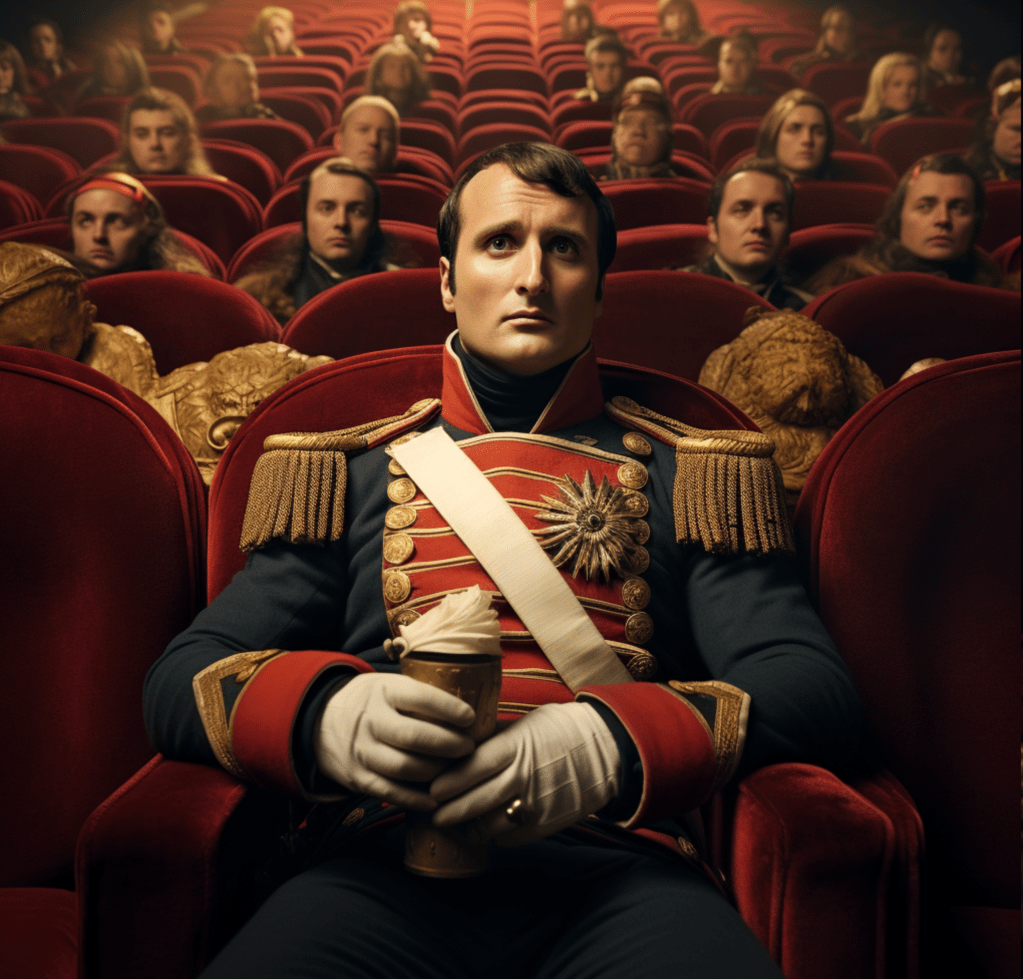
Graphic by Milena Targańska
What have I watched? That was the question I had intensely pondered at my leave from Westfield Mokotów’s Multikino on quite a confusing afternoon. I was surprised and disappointed at the same time. Delighted and outraged at the same time. Moved and unaffected at the same time. All in all, it took me more than a few discussions with my companions to solve this puzzling mess. As always, I had to stumble through my mixed blessing to answer even such a simple question as the one given here. This time though, something’s different – the dilemma seems to have been raised by many more, especially if one was to analyse “Napoleon”’s ratings. IMDB has gone only as far as 6.6/10, whereas Rotten Tomatoes spared nothing but a concerning 58% approval. Wondering why is that? I mean, we all heard about a few big names tied to that one, did we? Ridley Scott? Joaquin Phoenix? Vanessa Kirby? Those seem pretty familiar… What did then discourage? It has been about a month since the grand premiere of “Napoleon”; I suppose it’s time to dive deep into this work. Let me invite you to my analysis of both the decent and the “what went wrong” side of “Napoleon”.
Okay, so firstly, let’s stress out the core concept of the movie. Obviously, it is meant to be a biography of the controversial Napoleon Bonaparte. Delivered with a unique touch of Scott’s take on the matter, it presents the Emperor’s rise to power and, respectively, his downfall. The plot, starting in 1789 on the verge of the French Revolution, ends with the death of Napoleon himself in 1821. As such, the movie tells a seemingly complete story of Napoleon’s career. As you can see, nothing that surprising there.
Not so expected was this aforementioned unique touch of Scott. Naturally, as with every other biography, one was expecting merely an interpretation of the facts, yet “Napoleon” still managed to take one off guard. Why? Well, as a history nerd of some sort myself, I could not help but notice what was not to be noticed. Out of Bonaparte’s rocky career, the movie chose the events to include in the plot unconventionally. The dominating motif one could see all over the screen was Napoleon’s wife, Josephine. In the first half of the show, viewers were left to spend time mainly with her, only to visit her every once in a few scenes in the second part. Consequently, the director had to give up on a few other motifs. Among them, such irrelevant events as the battles of Jena, Friedland, or Leipzig, all marking Napoleon’s path to dominance, were not to be mentioned. As a result, the movie proved quite different from what I and probably other viewers were expecting. With the focus shifted from the military campaigns of the Napoleonic wars era to the more personal matters of Napoleon, we got to watch a completely different cinema.
Another factor one would be eager to mention is the portrait of Napoleon emerging from this unique take on him. Surely, Scott has included some of the commonly admitted traits of the Emperor. He’s proved, throughout those 158 minutes, courageous, charismatic, and domineering. Yet, it has not been a carbon copy of what historians claim Napoleon to be – he has been characterised also by loyalty, jealousy, and the so-called in the movie “lack of good manners”. Personally, again I was not anticipating that.
Finally, one has to at least mention the artistic input into the movie. Despite not being a fan of “Napoleon”, I did admire all the visual feasts I have been provided with as a viewer. The few battles that have been shown – Austerlitz, Borodino, and Waterloo, while not entirely realistic, proved exciting and of an impressive scale. The lighting was climatic. The grande shots of Marseilles, Paris, and Moscow were breathtaking.
In conclusion, Napoleon was surprising. With the plot focus unconventionally shifted to Napoleon’s more personal matters, the movie proved unique. Additionally, in the movie Bonaparte has been changed. Was this beneficial? Surely, it has confused some, while irritating others. After all, a completely distinct vision was proposed. Obviously, some do not and will not accept it. They will somewhat rightly depict it as inaccurate or audacious. Anyhow, there is nothing we can do.

 The Warsaw High School Times
Leave a comment