By Kami Dubno
Graphic by Rita Pasiewicz
“At some point in our lives we have all experienced mathematics in some way”, is what many corny maths teachers say to encourage learning the subject. The statement is true, but paradoxically, the number of people who claim to be bad at math is strangely big. So what is at the core of the ‘Math is hard’ idea, that pushes so many to fail at this universal subject.
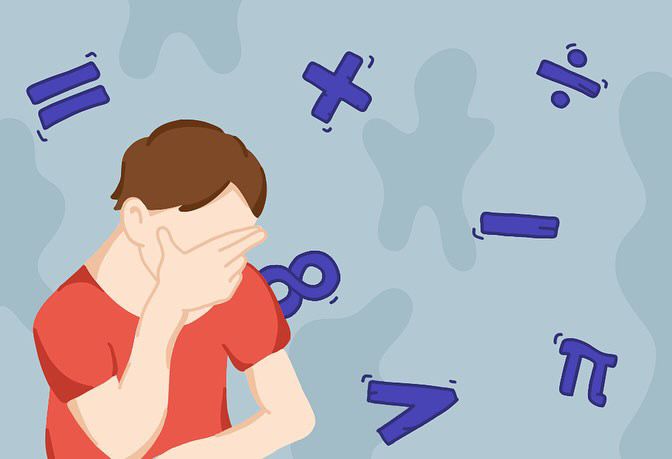
A persistent motif in this discussion is the people who provide the knowledge in the first place – teachers. How often have you heard your teacher say that you will fail, because “math is hard”? This phenomenon is called Math Anxiety and refers to the feeling of stress that occurs during the solving of a mathematical problem. Usually, this anxiety inhibits a person’s short-term memory, creating difficulty in doing mathematical operations. Why does it happen? While no conclusive evidence was found, many have pointed to the misconception of ‘maths being hard’ as creating expectations, which make someone feel anxious. Furthermore, the pressure of solving an equation quickly and in front of the class may exacerbate the stress.
Math anxiety could also be seen as a generational problem. If teachers and parents with math anxiety, will tell their children all the time that “math is hard”, no wonder that the child is crying while having to divide fractions. Moreover, making a simple switch up or mistake is highly probable, even for experts, which might perpetuate someone’s belief of their inability to do math.
If the odds are stacked against us in mathematics, how may we combat them? Math anxiety is no different from any other anxiety, so techniques used to treat the non-mathematical kind will work. Anything from breathing to exercise is helpful; however, there are some math-specific techniques. Firstly, virtually all mathematical problems at school are solvable, so knowing them allows our brain to look relaxed since there is some way of solving them. Secondly, many have pointed out that writing down allows us to dissect our preconceived notions of exercises, making them easier to take apart. Furthermore, knowing that anxiety does not define ability makes it easier to cope. Finally, a good teacher or tutor who inspires you to study math may break the curse of math anxiety.
However, math anxiety is not the only thing holding you back in mathematics. Current culture perceives the perfect math student as a male human-computer, where both can be debated. Looking deeper into the subject, numbers (and letters) are not the main idea, but rather ‘the art of problem-solving’. Math is as varied as any other field, having so many branches that there is at least one you are good at. Similarly, there can be areas that you do not get, but this does not make you immediately bad at the entirety of mathematics. Knowing this shows that the statement ‘I’m bad at Math’ is at best misguided and at worst damaging.
Many also see mathematics as strictly an analytical subject, but it is more creative than it may be believed. As previously mentioned, one thing tying all of mathematics together is the art of problem-solving. This means, that even if someone is bad at calculations, there is still room for being good at math. Many schools have already implemented a strategy where students receive points for showing data and working, while not having the correct answer. Furthermore, technology has also made it easier to see the creative, problem-solving side of math, since it allows us to focus on the method applied and interpretation of data. Finally, looking back at the most mathematical brains of all time, we see how creative math can get. How do you think Pythagoras discovered his famous theorem?
In summary, the idea of ‘Being Bad at Math’ is a statement with many flaws, since it perpetuates math actually being hard, placing great expectations on students, and allowing math anxiety to run rampant. Moreover, mathematics is so vast that the phrase loses meaning, especially because math is not just numbers and calculations, but rather creatively approaching ‘the art of problem-solving’.




 The Warsaw High School Times
Leave a comment