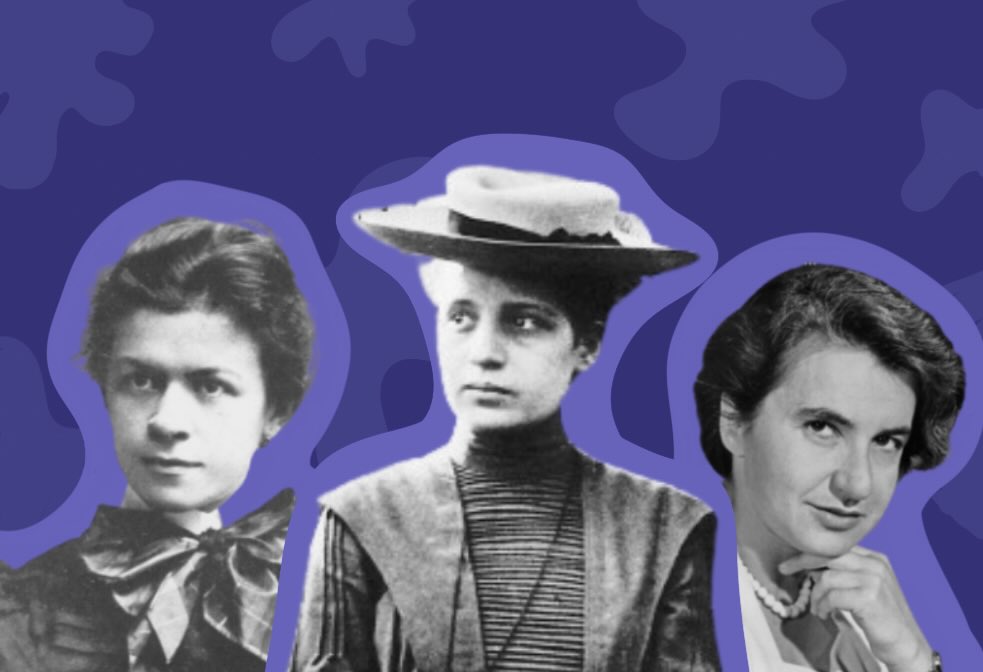
Graphic by Rita Pasiewicz
Since we were young, we have been hearing about scientists who made outstanding discoveries that led to their remembrance even after death. But have you ever wondered why there is such a huge disproportion between women and men in this field? Why probably the only really famous female scientist you have heard about is Maria Skłodowska-Curie, despite her being not the only one who had an impact on the way science functions nowadays. This article will explore some of the most interesting and attention-grabbing stories of other female scientists from all across the globe!
Mileva Marić
First of the many genius women I would like to present to you is Mileva Marić, wife of the famous physicist Albert Einstein, who was the individual responsible behind the crucial theory of relativity. However, it is likely that most of you do not know that, without his wife’s help, he would not have been able to come to the conclusion that E=mc2. But firstly, her story. Both of them had been admitted to a physics-mathematics course, which had only five students. Albert was not the one who was a so-called “academic weapon”; she was the one who passed all of the exams with top marks while he just barely passed them. It sounded like both of them would finish college and continue their work, but on the last oral exam, Mileva, who was also the only woman in this course, received 5 points while her colleagues received 11 or 12 points, which led to her not receiving the degree. Even though only one of them completed the course, she stayed with him and helped him with his research. He tried to persuade her to try to pass the exam again in September 1900 when he wrote to Mileva: “I look forward to resuming our new common work. You must continue your research – how proud I will be to have a doctor for my spouse when I will only be an ordinary man.” Unfortunately, she failed the exam again and came briefly returned to her birth country of Serbia. Later in Paris, they met Milos Jr., who described how during the evenings and at night when silence fell upon the town, the young married couple would sit together at the table and at the light of a kerosene lantern and would work together on physics problems. They calculated, wrote, read, and debated. They also attended meetings at her brother’s place, where Albert once declared: “I need my wife. She solves for me all my mathematical problems.” These two quotes are perfect examples of the statement that without his wife, Einstein would never be able to support his statement due to the amount of work Mileva had accomplished. Unfortunately, in 1912, Albert started an affair with his cousin, which caused their marriage to collapse. She decided to divorce him with the clause stating that if Albert ever received the Nobel Prize, she would get the money. Mileva moved to Zürich with their two sons, where she bought two apartment buildings as investments, which she unfortunately could not pay for due to the financial struggles. When in 1925, Albert wrote in his will that the Nobel Prize money was fully his sons’ inheritance, Mileva strongly objected, stating that the money was hers and considered revealing her contributions to his work. One of the most absurd pieces of advice she received from him was that: “When someone is completely insignificant, there is nothing else to say to this person but to remain modest and silent. This is what I advise you to do.” This is one of the saddest stories, and the most depressing thing is the fact that Albert never mentioned her contribution to his research and did not support her financially when she struggled to make a living. One thing which I would like you to keep in mind after reading her story is if you ever use Einstein’s work, remember that there were two people behind this discovery, not one.
Rosalind Franklin
During biology lessons you have most certainly learned about the way our DNA looks, but have you ever wondered who stands behind this discovery? Rosalind Franklin was working as part of a team led by Maurice Wilkins, which was searching for the structure of DNA. Franklin and Wilkins had clashing personalities, which caused them to work in relative isolation. He decided to search for company at “the Cavendish” laboratory in Cambridge where his friend Francis Crick was working with James Watson on building a model of the DNA molecule. Without her knowledge, both scientists saw some of her unpublished data, including the famous “Photograph 51.” The X-Ray diffraction picture of a DNA molecule was Watson’s inspiration, and by using her photo and their own data, Watson and Crick created their famous DNA model. Her contribution was not acknowledged, but fortunately, after her death, Crick said that her contribution has been critical.
Lise Meitner
As we all know, World War II was the time of many innovations and inventions, but often people who had contributed the most to these could not be fully appreciated due to their sex or race. One of these victims is Lise Meitner, who should have been honored with the Nobel Prize. Together with her nephew, Otto Frisch, she discovered how to prove nuclear fission and explained how her scientific colleagues had gotten it wrong. When scientists bombarded uranium with neutrons, they believed that the uranium nucleus, rather than splitting, captured some neutrons. These captured neutrons were then converted into positively charged protons and thus transformed the uranium into the incrementally larger elements on the periodic table of elements – the so-called “transuranium,” or beyond uranium, elements. She thought that, rather than radium, the element in question might be barium – an element with chemical properties similar to radium. After the discovery, they realized that all of Meitner’s ideas were correct, but unfortunately, she had two problems: she was a Jew living in Sweden as an exile, and she was a woman. It could have been possible to overcome each of these difficulties separately, but at the time defeating both was impossible. When she was forced to leave Germany, Meitner decided to continue her work on nuclear issues with Hahn and his junior colleague Fritz Strassmann through regular correspondence. When Otto Hahn published their findings, he decided to not include her in the contributors because he was scared that he may lose his career in Germany, so he claimed that the discovery was based solely on insights gleaned from his own chemical purification work, and that any physical insight contributed by Meitner played an insignificant role. Hahn, however, had trouble explaining his own findings. In his paper, he put forth no plausible mechanism as to how uranium atoms had split into barium atoms. But Meitner had the explanation. So, a few weeks later, Meitner wrote her famous fission letter to the editor, ironically explaining the mechanism of “Hahn’s discovery.” Unfortunately, it did not help her situation, and in 1944, the Nobel Committee awarded Hahn alone with the Nobel Prize in Chemistry “for the discovery of the fission of heavy nuclei”. Paradoxically, the word “fission” never appeared in Hahn’s original publication, as Meitner had been the first to coin the term in the letter published afterward. Until her last days, Meitner’s contribution was not recognized by the Nobel Committee; the only award she had received was in 1966 when the U.S. Department of Energy jointly awarded her, Hahn, and Strassmann its prestigious Enrico Fermi Award “for pioneering research in the naturally occurring radioactivities and extensive experimental studies leading to the discovery of fission.”
There are many other brilliant but underrated women in science whose stories should definitely be shared and discussed, and we may never truly know how many discoveries made by women were appropriated or stolen by men throughout human history. However, with great strides being made in terms of gender equality, it is perhaps everyone’s hope that such cases will not happen in the future.



 The Warsaw High School Times
Leave a comment