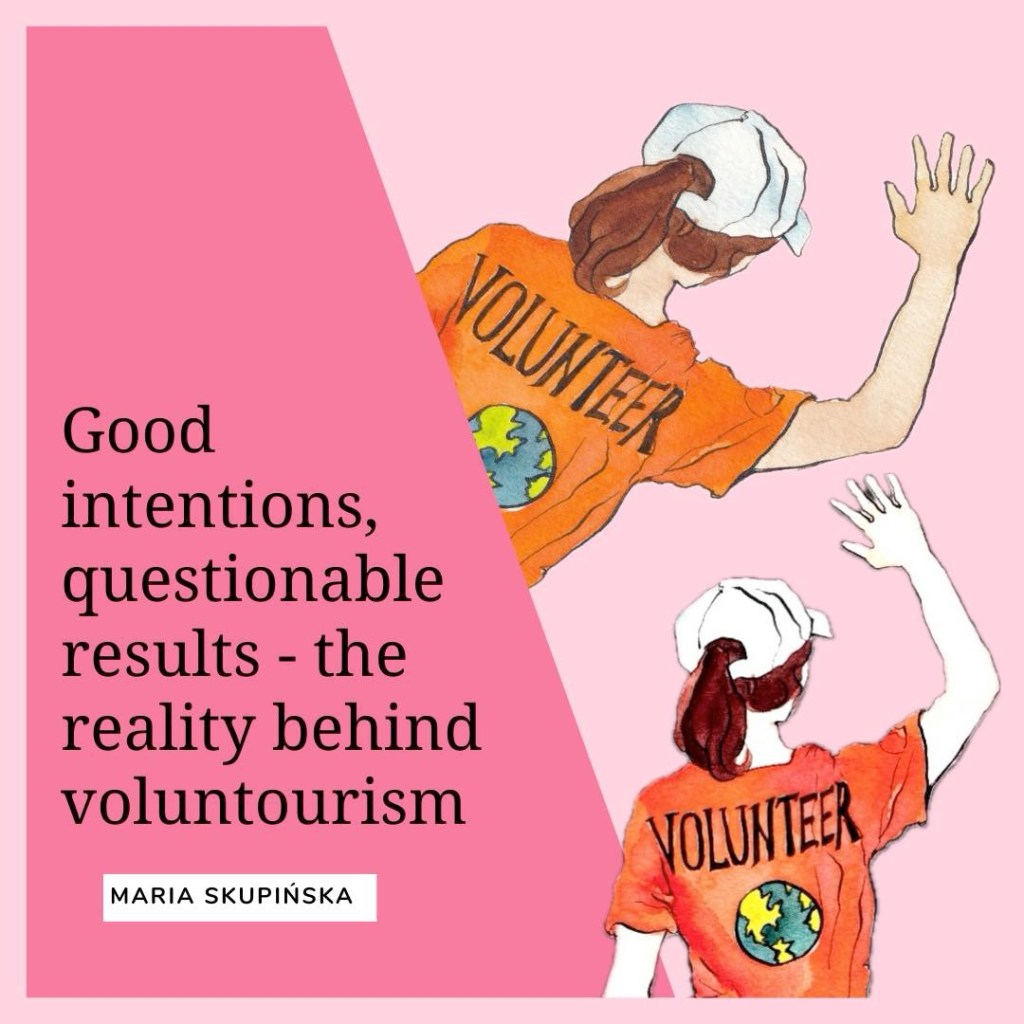
By Maria Skupińska
Designed by: Martyna Zbucka
In the search of new opportunities, people strive to combine personal growth with empowering others. While some prefer to work within their local communities, others choose to travel afield and dedicate their efforts to uplift the most marginalised regions. Experiencing an adventure consisting of an unprecedented opportunity of discovering other cultures combined with simultaneously helping out those in need may seem like an unblemished prospect providing mutual benefits. However, beneath the surface of a seemingly flawless initiative, many factors need to be taken into consideration before planning such venture.
The term ‘voluntourism’ emerged from the combination of the words ‘volunteer’ and ‘tourism’. The activity includes participants travelling to the underserved nations or regions to perform voluntary work, typically for charitable causes. Volunteers are employed to engage in various types of community service that range from education to construction work for a set period of time.
While the avidity to help the less fortunate is undoubtedly a noble trait, and many of the volunteers approach the endeavour with genuine altruism, both their activity, and, most notably- the business of voluntourism as a whole, have been repeatedly criticised for causing more harm than good.
Employing people who possess the sufficient skill and expertise, especially in an instance where there are severe market shortages in a given community, is likely to enhance the prosperity of the work. However, inexperienced volunteers, even despite having good intentions, may not deliver competent performance and even require for their work to be corrected by members of the local community. It eventually results in the excessive use of valuable means and resources, which, was it for the adequate allocation, could have otherwise benefited the community.
While the perspective of it might be a dark one, the people in the position of power in the underserved regions often opt for raising money by entrusting the work to an underqualified volunteer who provides funds in excess rather than spending it by employing a local worker with an appropriate skillset. As a result, members of the community are deprived of jobs and salary which only further exacerbates the dire issue of unemployment and severe poverty.
Additionally, many have pointed out that the short – term volunteer activity, typically lasting no longer than a couple of weeks, only offers temporary solutions to all the difficulties the Global South continues to face throughout history. Instead of empowering the communities by providing knowledge on practices that would enable the independent and sustainable development, it creates a reliance on foreign aid, reinforcing the view of Western saviourism.
While the concers regarding the performance volunteers have been an initial point for some criticism, the most acute problem of voluntourism lays within the industry itself. The existing model tends to prioritise the experience of participants over the needs of local communities, which, in worst cases, leads to the severe exploitation of the vulnerable populations. Children are the group most exposed to such actions, as orphanages are often chosen as a place of service by the volunteers who are willing to pay for the experience.
People in positions of power in Haiti, Uganda, Cambodia, Guatemala and many other countries have turned orphanages into lucrative business, fueled by foreign donations from wealthy nations and volunteer funding. It is commonly encountered that parents are encouraged, or even payed for, to institutionalize their children under the pretence of providing them with proper care and education, to which international tourists are hoping to contribute with both money and labour. In reality, most of the monetary means of support provided by the participants is not used to support children, but to host them in touristic infrastructure or enrich the administrators in charge of the facilities.
Challeging oneself and seeking new opportunities is certainly commendable, given it is alongside the disposition of helping the less fortunate. However, remaining selfless and genuine in the desire to uplift and facilitate the development for vulnerable communities is a key factor enriching the initiative with valuable results. Volunteering activity in the developing regions requires more than just good intentions – it demands a passion – driven attitude backed up by a strong skillset and commitment to sustainable development. It is crucial for that the volunteers work on behalf of a reputable and transparent organisations that collaborate with local workers in ensuring the meaningful, long – lasting change in the community.
References:
- https://www.nationalgeographic.com/travel/article/unpacking-voluntourism-five-myths (07.01.2025, 09:10 PM)
- https://www.theguardian.com/news/2018/sep/13/the-business-of-voluntourism-do-western-do-gooders-actually-do-harm (07.01.2025, 09:10 PM)
- https://www.rosterfy.com/blog/voluntourism-good-and-bad (07.01.2025, 09:10 PM)
- https://experiencingtheglobe.com/volunteering-in-africa/ (07.01.2025, 09:10 PM)
- https://www.worldvision.ca/stories/voluntourism-the-good-and-the-bad (07.01.2025, 09:10 PM)
- https://www.american.edu/sis/news/20241023-navigating-intentions-in-the-voluntourism-industry.cfm (07.01.2025, 09:10 PM)




 The Warsaw High School Times
Leave a comment