By Maria Skupińska
Design by: Martyna Zbucka
At first glance, philosophy and pop culture may not exhibit profound similarities- one rooted in intelectual meditation, whilst the former emerged from societal need for entertainment. However, immerse examination and analysis of mass audience content may often reveal references derived from various philosophical concepts, often incorporated to enrich the narrative and elevate the message.
‘The Matrix’ was a groundbreaking cinematic work, both in terms of the technological advancement and conceptual depth. One of the philosophical themes most associated with the movie is the examination of the relation betweem reality, symbols and society pursued by Jean Baudrillard. At the beginning of the film, Neo, the protagonist, uses a hollow copy of the Baudrillard’s book- ‘Simulacra and Simulation’ to hide his precious possesions, which indicates the overt allusion to the philosopher’s ideological record.
A simulacrum, by Baudrillard’s definition, is a copy that has never imitated any real occurance or cesead to do so once its original inspiration faded. It is a mere symol, sometimes created solely for the purpose of escaping the real world, yet imprinted so vividly in the collective consciousness that the reality becomes irrelevant. The final stage of simulacra indicates the complete detatchment from reality- an occurance in which the society is so ingrained in the simulation it no longer seeks any relation to the truth. The distinction between reality and simulation becomes impossible, shifting the humanity towards what Baudrillard defined to be a ‘hyperreality. As a result, the simulacra no longer imitate the reality, but replace it entirely.
In the Matrix there is a striking discrepency between the reality and the artificial realm created by the machines. A dystopian world unsuited for humans contrasts with a relatively comfortable, although false, hyperreality operating on illusions which shaped the worldview of people living in it. The simulation is implemented to maintain control over the humanity, confining their conscious beings in the illusory realm while their physical bodies are used as a powerhouse for the infrastructure in the machine- run world. However, the real and simulated worlds in ‘The Matrix’ are distinctly separate. Those who escape the Matrix retain a clear separation between the reality and illusion, diverging from the Baudrillard’s concept in which the dissimilarities no longer exist.
Although the movie seems to clearly had referenced Baudrillards work, in one of the interviews the philosopher referred to it in these words: ‘The Matrix is surely the kind of film about the matrix that the matrix would have been able to produce”. The philosopher criticised the movie for entirely missing the point of ‘Simulacra and Simulations’ and failing to grasp his ideas in general. While the general public has agreed upon the Baudrillard’s critique in terms of the first movie, several voices have been raised that it is not particularly applicable in the context of the whole franchise.
‘The Matrix’ was designed to reference the postmodern problem of simulation, yet the approach taken by the Wachowski’s seems to be more resemblant of the classical idea of illusion, particularly the one presented by Plato in one of his most renowned ideas- the allegory of the cave.
In this allegory, prisoners are chained to the wall of the cave, able to percieve only the shadows cast on the wall in front of them. Those shape the reality of the observers, who have never been exposed to the real world. When a prisoners escapes to the outside world, after an initial disbelief to the completely unfamiliar reality, they become englighted and return to the cave to share their discovery, only to be met with dispelief of those still imprisoned.
The similarities between this concept and the plot of The Matrix are rather evident. Born and raised in the simulation, the humanity is unaware of the reality beyond the projection produced by the machines. Those seeking the truth by taking a red pill in the movie correspond with the fugitives from the cave, suddenly emerging out of the simulated realm into the real world.
In this very moment, one particularly significant difference comes to light. In the Plato’s allegory, the world outside of the cave represents a fulfilling and pleasurable place, ultimately beneficial for the human to be aware of, whilst the machine- run reality outside of the Matrix is a dystiopian, descent world unsuited for the humankind. This may prompt the further reasoning, that, although for its falsity, the simulation may be a preferred altrnative in comparison to the real world.
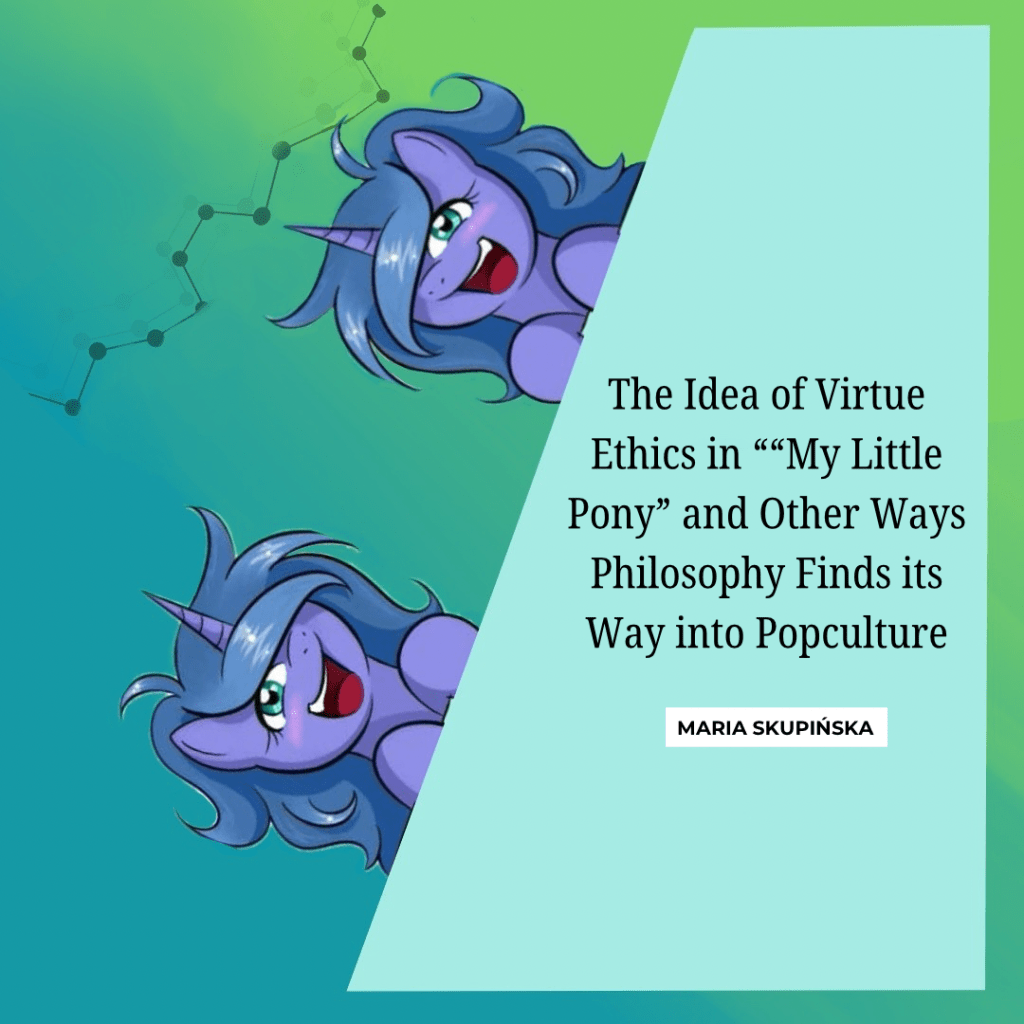
Apart from the instances similar to ‘The Marix’, philosophical themes often operate more subliminally in the popculture.‘My Little Pony’, a joyful series set in the harmonious realm of Equestria, weaves profound philosophical narrative into its plotline.
In the MLP universum, all ponies receive a ‘cutie mark’ at a certain age, which is to determine their vocation and unique talent. Following their designated path, the characters can gradually grow in their appointed field of specialisation; baking, tailoring farming among many others. This allows them to perfect a particular skill and serve the community efficiently, in accordance to what they know best. One of Plato’s most eminent pieces- ‘The Republic’- describes this exact occurance as the division of labour in the utopian society. According to his narrative, achieving the maximum effectiveness and prolificity in production requires each individual to excell in a particular role. Aligning their talents and joint efforts, the ponies contribute to supplying their community with goods and services of the highest quality.
Similarly, the show resonates with Aristotle’s contribution to the idea of the virtue ethics. Each of the main character’s actions and decisions is shaped by their core trait, such as loyality in case of Rainbow Dash. Ponies are meant to cultivate and practice the virtues, which guides them to the state of eudaimonia, described as human flourishing and fulfillment. ‘My Little Pony’ captures this concept throught the ‘Elements of Harmony’- supernatural artifacts embodying each character’s virtue.
Apart from the aforementioned examples, there are countless other philosophical references in the popcultural output. Whether the plot is designed to connote a certain idea or only resonate with it subtly, these allusions often serve as a factor enhancing the storytelling, as well as the general message of a particular cultural creation. Interwining philosophical themes with the narratives familiar to a vast group people can challenge the audience to engage critically in the content, sometimes even subconsciously, as well as evoke appreciation and interest of the general public towards a particular conceptual framework.
- All I’m Offering is the Truth | The Philosophy of the Matrix – YouTube (19:00, 14.01.2025)
- https://www.youtube.com/watch?v=7CDGAHI3_tA&t=98s (19:00, 14.01.2025)
- https://www.youtube.com/watch?v=NrSBUYfWap0&t=52s (19:00, 14.01.2025)
- https://nofilmschool.com/philosophy-of-the-matrix (19:00, 14.01.2025)
- https://einzelganger.co/all-im-offering-is-the-truth-the-philosophy-of-the-matrix/. (19:00, 14.01.2025)
- https://www.degruyter.com/document/doi/10.1515/krt-2021-0038/html?lang=en&srsltid=AfmBOooL4s2EEYS3spdEXFEi3FTTfGwCDV0eFhXJAn5XBrNwN-saCUi8#j_krt-2021-0038_ref_106 (19:00, 14.01.2025)
- https://www.sparknotes.com/film/matrix/section1/page/2/(19:00, 14.01.2025)
- https://www.overthinkingit.com/2012/11/08/my-little-pony-plato/(19:00, 14.01.2025)
- https://analysisismagic.wordpress.com/2013/08/06/the-equestrian-polis-my-little-pony-and-aristotles-politics/(19:00, 14.01.2025)
- https://www.thelivingphilosophy.com/p/why-baudrillard-hated-the-matrix (19:00, 14.01.2025)
- https://en.wikipedia.org/wiki/Allegory_of_the_cave (19:00, 14.01.2025)



 The Warsaw High School Times
Leave a comment