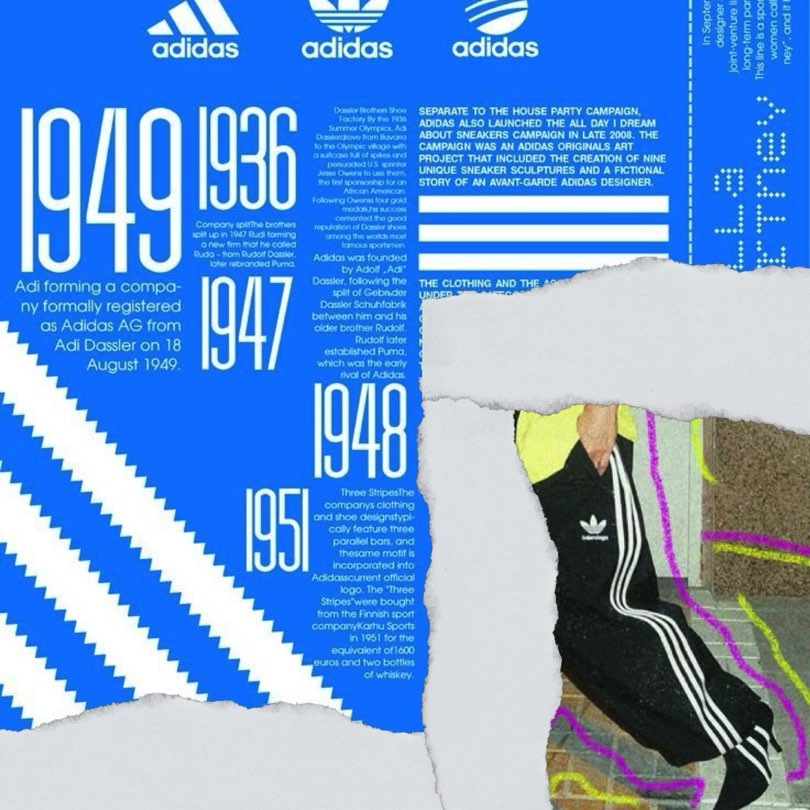
In the Eastern European landscape, few symbols are as deeply embedded as those that bring together defiance and tradition. The recent popularisation of the ‘Slavic doll’ aesthetic has shaken the typical Eastern European imagery, however, despite thin, blonde-haired models the most vivid image of Slavs remains that of a profoundly vulgar individual, blasting hardbass while squatting in the middle of the Soviet-style housing estate. The completion of this impeccable image demands a final, essential element- a three-striped tricot tracksuit. However, the history of Adidas’s iconic garment captivating the hearts of young Slavs goes far beyond a mere stereotypical trope; it is a story of generational resilience and cultural identity breaking through the thick wall of demanding, Soviet and post- Soviet reality.
The idea behind Adidas first came to life in 1924 in Germany, initially founded under the name of Gebrüder Dassler Schuhfabrik by brothers Adolf and Rudolf Dassler. After a major clash of visions, the two parted ways – Adolf launched a solo sportswear venture that would eventually be renamed to what we know today. The latter half of the 20th century saw Adidas expand its reach across international markets, and despite the Soviet Union’s staunch ideological resistance to Western influence, it was no exception.
Adidas’s rise in prominence in Eastern Europe was expectedly intertwined with a major sports event; the 1980 Summer Olympics hosted by the USSR. By equipping Soviet athletes with necessary gear, Adidas introduced innovation to the homogenous state-run market, subtly bridging the chasm between the Eastern bloc and near-mythical allure of the West. Ever since then, Adidas’s garment became a symbol of luxury and status while simultaneously gaining recognition in the broader, political context of foreign influences in the strictly controlled state.
Although the cornucopia of Western influences flooding Eastern Europe after the fall of the Soviet Union had the potential for destabilising Adidas’s position in the region, the brand managed to maintain its strong reputation. The freshly embraced Western lifestyle thrived in the emerging capitalist society, setting Adidas tracksuits, footwear and other apparel as monuments of youth rebellion and a statement of freedom from the constraints of Soviet life. It became the very essence of streetwear in the emerging Slavic popculture, taking a slightly rebellious edge linked with the gritty urban lifestyle; an element weaved into the everyday life of Slavs in the rapidly changing world.
The newly established cultural norms had a lasting impact on identity and self-expression, which, at that time in Eastern Europe, was freer than ever. It became a catalyst for the emergence of various subcultures, among which the Gopnik culture bore particular significance. The term ‘gopnik’ – widely used to describe workers and individuals from the lower socioeconomic background – carried a somewhat negative connotation, associating the movement with roughness, minor criminal activity and disrespect for authority. In this sense, gopniks represent the rejection of formal societal norms, resilience and authenticity, which, accompanied by a three- striped tracksuit, paints a perfectly complete picture of a stereotypical Slav. The anti- establishment ethos of the subculture aligns seamlessly with the symbolic resonance of Adidas, long associated with post- Soviet defiance and youthful rebellion.
By the turn of the millennium, globalisation in Eastern Europe reached a point where regional identities began to merge with ubiquitous global trends. In response to a growing desire to preserve the authenticity of traditional streetwear, Russian fashion designer Gosha Rubchinskiy partnered with Adidas for the Spring/Summer 2018 collection, creating a nostalgic line inspired by the post- Soviet apparel. Widely acclaimed, the collaboration was recognised as a tribute to contemporary Slavic fashion and the reaffirmation of Adidas’s role as a cultural innovator with enduring influence.
While the iconic three-striped tracksuit is what marks Adidas’s presence in Eastern Europe in a material sense, it is the brand’s deeply ingrained identity and symbolic value that has solidified its status as a Slavic cultural phenomenon. In a region constantly renegotiating its place between past and future, Adidas continues to embody of resilience, cultural identity, and authenticity of young Slavs, transcending its stereotypical associations to become a symbol of persistent relevance.
Sources:
- https://www.theskinnybeep.com/2017/06/gosha-rubchinskiy-spring-summer-2018-mens-collection-saint-petersburg/
- https://en.wikipedia.org/wiki/Adidas
- https://officemagazine.net/gosha-rubchinskiy-ss18
- https://www.new-east-archive.org/features/show/8522/new-east-100-avdotja-alexandrova-lumpen-russia
- https://en.wikipedia.org/wiki/Gopnik




 The Warsaw High School Times
Leave a comment