By Maria Skupińska
*Sight* I would like to sincerely apologise to all of those who felt deeply offended or directly affected by my deeds. I thereby wish to express genuine remorse from the bottom of my heart *teardrop* and promise to never repeat such misconduct. We are all humans, we all make mistakes, what is truly important is to treat those as a lesson and march onto the new path towards redemption *picture fades, the screen slowly turns black*.
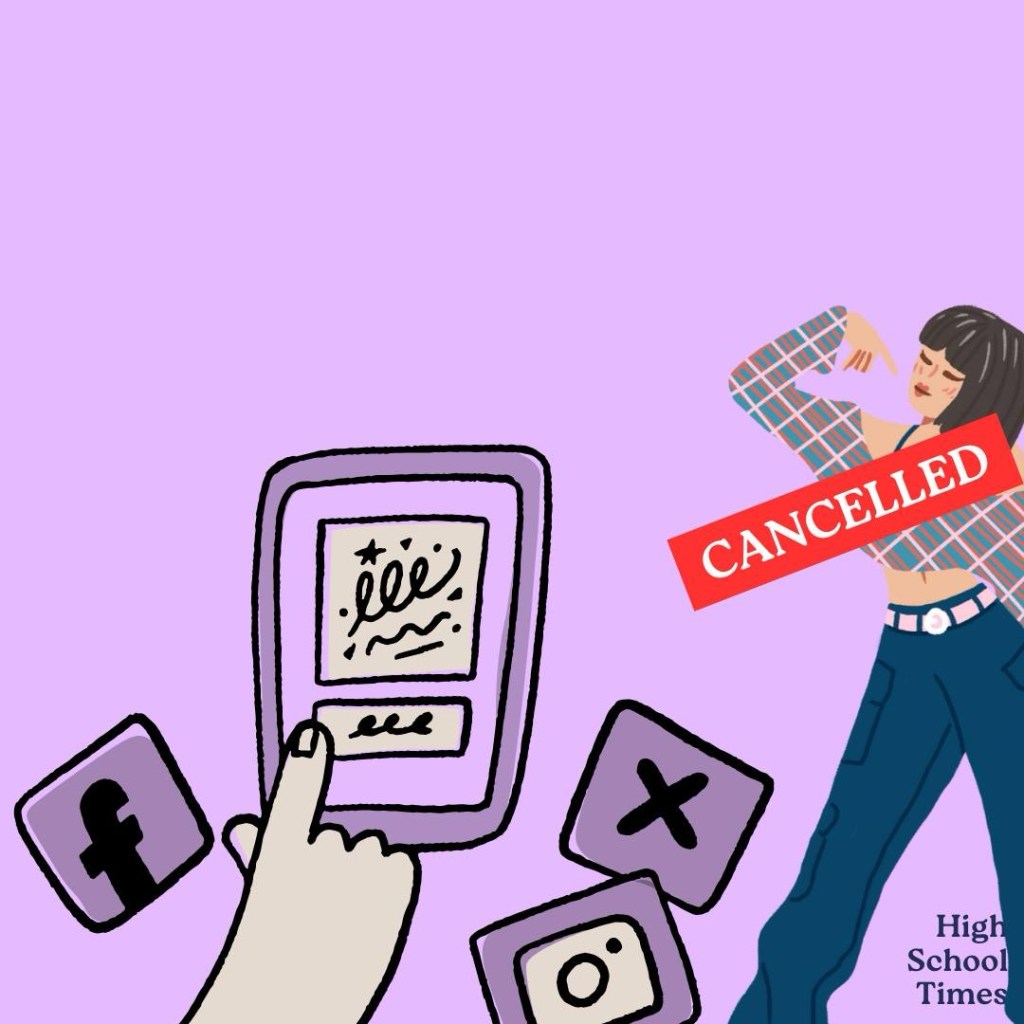
This blueprint, although often seen in altered forms, constitutes the structure of the majority of the so-called “apology content” published by celebrities in the face of immense public backlash. Widespread callouts and societal demands for accountability largely shape the phenomenon of cancel culture, concurrently perverting the definition of genuine remorse to an extent where the public is satisfied by the sole act of apologising. Although public shaming and ostracism existed long before the internet, it is the emergence of social media that accelerated the fluidification of reputational standards. A person’s image can be destroyed as quickly as it can be rebuilt, exposing the fundamental shortcomings of frequent cancellations.
Prior to the digital age, grave transgression and misconduct were dealt with through public shaming. The scarlet letters worn amidst the 17th century to signify individuals convicted of adultery in Puritan societies, along with public trials and executions frequently employed throughout history, are among a plethora of punitive means applied to those who stepped outside accepted norms. These were, however, only relevant within certain communities due to the slow and fragmented nature of communication.
The emergence of the internet signified a turning point in public judgement. With information instantly accessible to everyone, a single image or video could spark a global wave of outrage, directly exposing internet personas to mass scrutiny and increasing the likelihood of accountability in cases of misconduct. In this sense, social media became a double- edged sword; defined by speed and spectacle, it has not only amplified calls for justice but also distorted the very meaning of accountability itself.
When met with cancellation, public figures tend to act in a predictably similar manner, publishing carefully worded apologies, either through their platforms or by bringing up the matter in interviews. Saturated with the passive approach and vague references, those declarations usually closely resemble the aforementioned blueprint, thereby lacking genuine self- reflection or a deep understanding of the harm caused. This phenomenon was famously exemplified by Logan Paul, an American YouTuber publicly denounced after the publication of a video showing a dead body in Japan’s “suicide forest”. Following the incident, the creator issued an apology video, widely criticised as opportunistic and insincere, especially as he swiftly returned to posting monetised content and rebuilding his reputation. This illustrates how public apologies often serve as strategic damage control rather than proof of genuine remorse, leaving the audience with no amends or visible behaviour shift.
While the fault of wrongdoing quite obviously lies with the offender, it is the public that often fails to sustain its demand for accountability. Fatigued after a few weeks – or even days – of intense backlash, the public’s attention is captured by another scandal, leaving previous controversies unresolved. Such an instance was seen in case of James Charles, a beauty influencer who faced serious grooming allegations. His widely circulated apology video titled “Holding Myself Accountable” faced initial backlash – but within months, he resumed posting content and retained a large fanbase, revealing a rapid shift in the public opinion despite the absence of meaningful actions or growth.
Those situations highlight a particularly prominent issue regarding the cancel culture: selective outrage. The term describes instances in which similar transgressions are treated unequally. Popularity, charisma, or complex PR work often hold the power to rehabilitate a public figure’s image without an actual change in behaviour. Social media have created an environment in which outrage becomes just another form of entertainment – consumed eagerly and emotionally, but without lasting commitment.
By confusing public shaming with genuine justice, cancel culture risks leaving problems requiring a more thorough consideration untouched. Although it is easy to demand a hollow apology, provoking a genuine change fuelled by utter remorse is immensely difficult. In world obsessed with rapid reactions and instant redemptions, the slow and deliberate process of real transformation often feels alien – and is all too easily abandoned.
Sources:
- https://www.pewresearch.org/internet/2021/05/19/americans-and-cancel-culture-where-some-see-calls-for-accountability-others-see-censorship-punishment/ [21:10, 27.04.2025]
- https://www.nytimes.com/2020/12/03/t-magazine/cancel-culture-history.html [21:10, 27.04.2025]
- https://en.wikipedia.org/wiki/Cancel_culture [21:10, 27.04.2025]
- https://www.britannica.com/procon/cancel-culture-debate [21:10, 27.04.2025]
- https://medium.com/@mjtoby1020/reality-check-the-funny-thing-about-selective-outrage-8663d55ade3c [21:10, 27.04.2025]

 The Warsaw High School Times
Leave a comment