By Oleksandr Koliakin
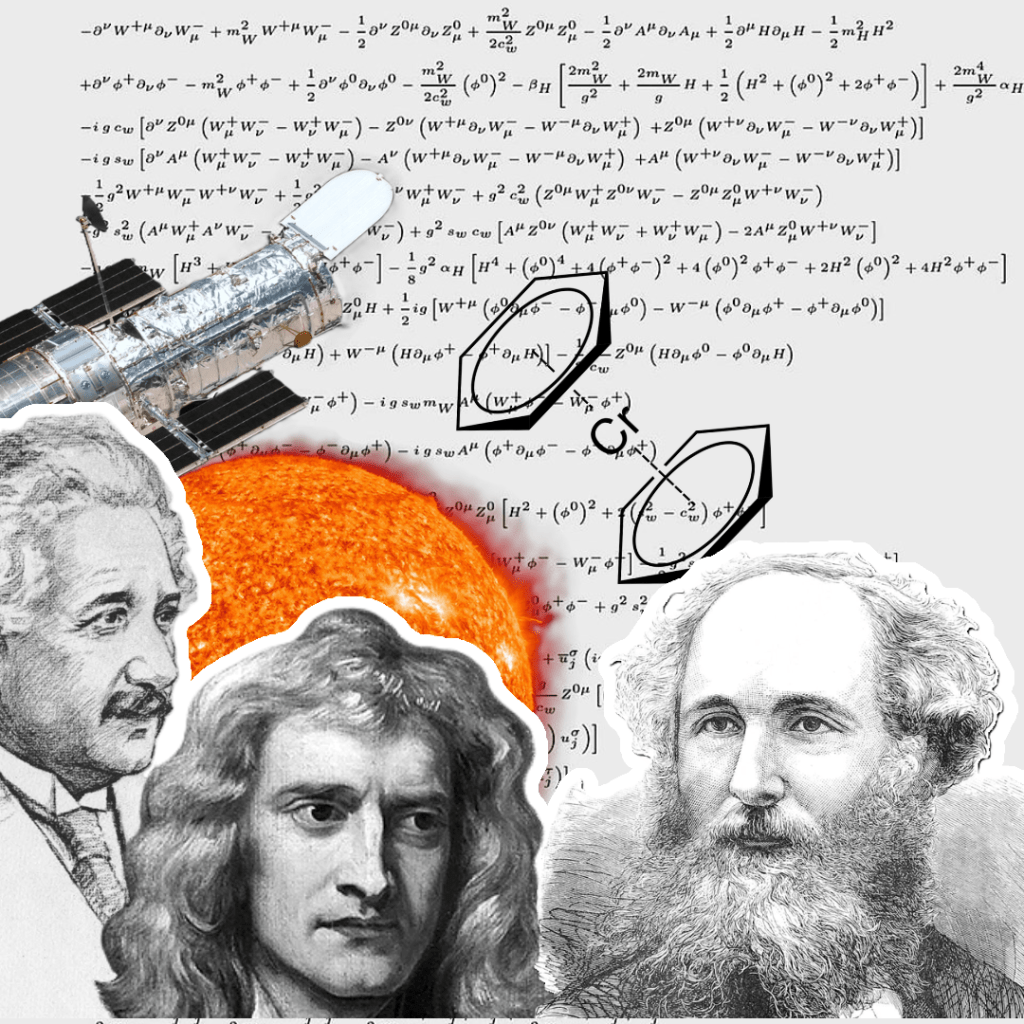
The idea that science must be accessible to everyone is beautiful. “Popular science” is a brilliant thing, allowing people without PhD-level mathematics to learn about fascinating concepts. It is these books and videos that first convinced me, and (I am sure) many young enthusiasts, to pursue careers in STEM.
However, accessibility often comes with hidden costs.
Take Stephen Hawking, for instance, one of the most brilliant minds of the last several decades. One of his most prominent works, A Brief History of Time, is a book that helps introduce elementary particle physics, relativity and cosmology in a very friendly way. Yet, a prominent chapter on the explanation of Hawking Radiation, a concept Dr. Hawking himself discovered, employs a metaphor that is conceptually incomplete. While elegant, it may lead aspiring physicists to a dead end: a “half-truth”.
For those interested, the description presented in the book is that particle-antiparticle pairs appear right near the event horizon of the black hole; the antiparticles “fall in”, while the particles appear to be “emitted”. In practice, Dr. Hawking’s actual theory regarding Hawking radiation is notably different, involving complex quantum theory and relativity.
Why?
Stephen Hawking is undoubtedly correct in believing that complex mathematical explanations (required to describe the actual phenomenon) would turn away eager readers. Still, the confidence with which the argument was presented made me (and, I am sure, many other children) believe in an incorrect explanation. The metaphor created a false mental image: that radiation occurs only at the edge, rather than being an inherent property of the space around the black hole. Its danger is eliminating crucial nuance, while not providing the tools to allow enthusiasts to progress further in the field.
There are many other misconceptions perpetuated by many popular science channels, many of which, I am sure, unknowingly. A popular one, for example, is the common presentation of quantum computers compared to the classical ones (regular smartphones, laptops and PCs you have at home). A lot of media seems to suggest that, while classical computers perform calculations or comparisons one-by-one, quantum computers do them simultaneously. I think that this is one of the main ideas misleading many aspiring quantum enthusiasts.
However, there are far worse examples too. Intentionally “clickbait” articles, for instance, often resort to pure sensationalism to attract readers. Take discussions on Schrödinger’s Cat, for instance: many pop-scientists try to seemingly present this as “quintessential quantum mechanics”, sensationalizing the “dead and alive” cat thought experiment. In reality, Schrödinger himself created this example to present (what he believed to be) the absurdity of an existing view of quantum mechanics at the time.
Other times, magazines often write articles on what appear to be “monumental breakthroughs”, which often turn out to be far more minor than initially thought. Even I, having studied quantum mechanics for months, recently fell for the apparent buzz regarding one novel elementary particle physics theory.
A good critique may be “who cares?” After all, popular science’s primary purpose is to serve to satisfy a casual interest in STEM fields, and encourage children (both very noble ideas), not provide a PhD-level education. That is a point to be made: any person encouraged enough to pursue the field professionally will naturally have their knowledge of this area corrected, (hopefully) removing popular-science-induced misconceptions.
I would argue, however, that that is not the point. First of all, the provision of misleading information can lead to confusion for the very students that were so excited by the field, reflecting both in their understanding of it and passion for it. Who knows, would a student who thought quantum computers are essentially omnipotent, based on pop-sci descriptions, still want to work on them after discovering that they are not what they are commonly advertised as?
Second of all: why?
Yes, simplifications in popular science are inevitable. Many education systems are based on this premise: a simple concept evolved throughout the years, with a small layer of complexity added each time. Take the atomic model: all schoolchildren are taught the Bohr model (flawed, but useful for many calculations) before moving on to the “correct” quantum mechanical version, involving complex orbitals.
However, there is a difference between simplification and the presentation of a misconception. Popular science outlets often have large followings and so wield large influences. Surely, it should always be the duty of the scientific community to ensure the delivery of truth, especially if the figure in question has an audience in the millions.
I do not claim that popular science outlets are evil; as mentioned many times, I believe that they are doing an amazing and vital service. Stephen Hawking, meanwhile, aside from making incredible discoveries to advance humanity’s knowledge, also inspires generations of children (including me) to do the same. However, I believe that we must point out when people and outlets go beyond simplification: misrepresenting facts either unknowingly, not taking the time to properly verify the information, or knowingly, especially if trying to increase their content output and attract viewers.
How that accountability will look is a different question entirely. I believe that there are at least two places to start: ensuring that, in texts published by famous scientists, content that is simplified to the extent that it is “misleading” is explicitly stated to be at least “not fully correct”, as well as bringing to light the sensationalist practices of pop-sci websites when it directly leads to the notable distortion of the truth. Community notes, as on certain social media platforms, would certainly help in that regard: there is no shortage of scientists wishing to clear up misunderstandings. While Wikipedia is commonly labelled as an “unreliable” source, I would say that their moderation methodology is unmatched: it is exactly what makes Wikipedia’s science articles sound precise, and a standard for outlets to strive towards.
Yes, the process may be difficult; I am sure that better solutions can be found. However, in an age where misinformation is a critical problem, one must also address misconceptions in science.
Popular science is, first and foremost, anything that presents STEM in a “friendly” way, accessible to all. However, we must not equate accessibility with misinformation.
This is an opinion piece written by an individual within The Warsaw High School Times. Any information or claims presented here are solely the perspective of the author, and do not necessarily present the organization’s stance on the matter.



 The Warsaw High School Times
Leave a comment